

As I was working on The Exit Blueprint, I created some visualizations to capture the concept of leveraging self-employment to exit the 9-to-5 world early. Side note: I created them in Keynote by hand, instead of using AI. Wild, right? Anyway, the goal is to enjoy your life more in the second half than traditional employment models allow (before it’s too late).
Yes, I know they aren’t a perfect visualization that captures all scenarios for all people. They are a bit simplified. But I hope the general ideas are being conveyed well enough to make my point.
Traditional employment and retirement
Our traditional model of employment and retirement creates a life that looks something like you see below. It is undeniable that we spend significant percentages of our lives in the educational system and the working world. It’s significant both in terms of the total years we spend in those modes (i.e., school and employment) and the percentage of our daily lives dedicated to them (e.g., 8-12 hours/day).
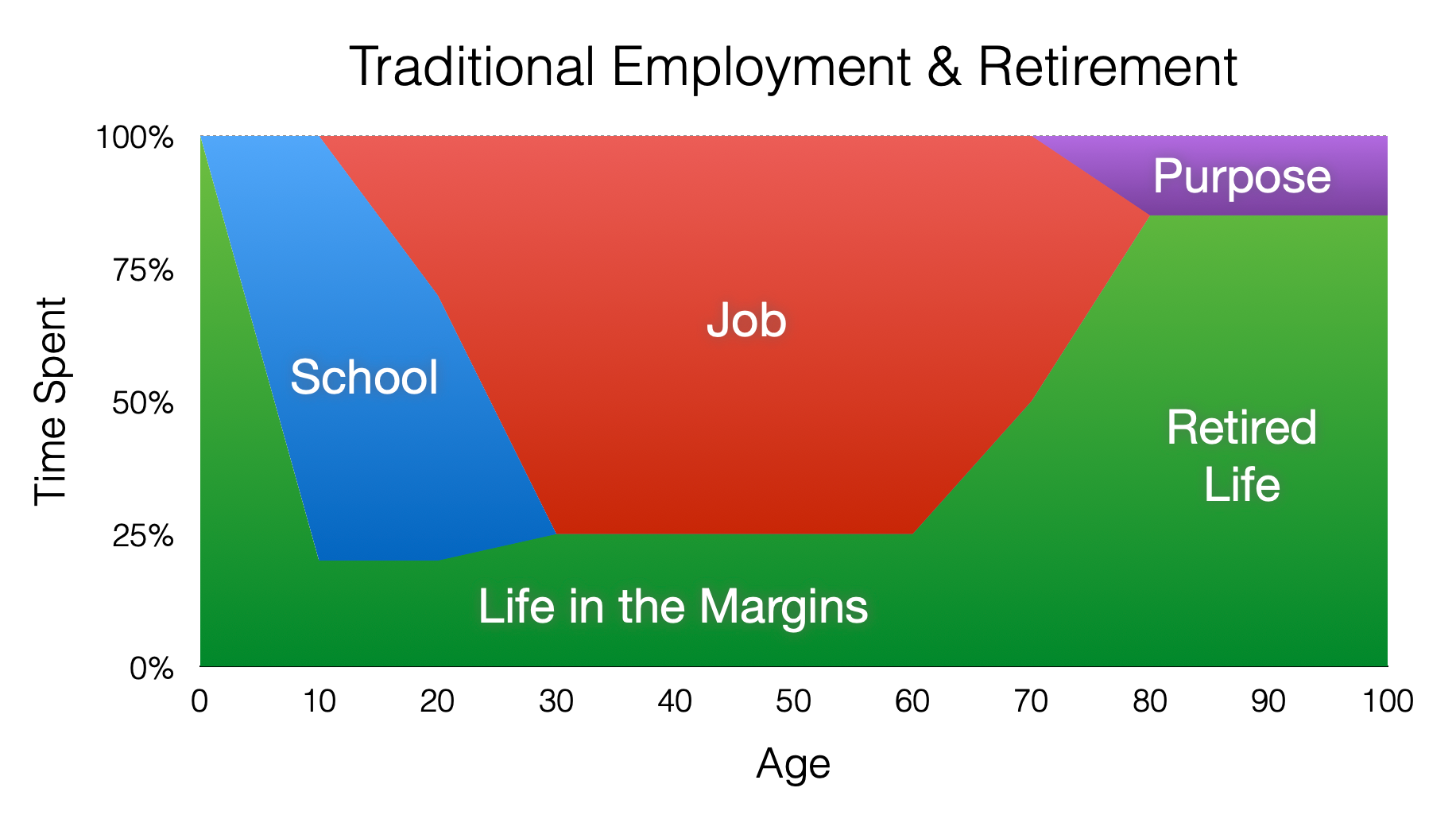
We enjoy a relatively carefree childhood for a few years until we start school. Some children enter school or a school-like environment very early, while others may only do so later (e.g., at 5 or 6 years old).
Education consumes the rest of our young life until our 20s, depending on how much college or postgraduate education we pursue. Heck, I was almost 30 by the time I finished my Ph.D. in psychology!
I labeled the green zone “Life in the Margins” because the freedom to enjoy your personal life is pretty minimal—with a little time during the evenings and weekends. Many of us spent even more time outside the classroom studying and working part-time jobs. I certainly had little time for a personal life in those 25 years of being in the educational system (since I also worked part time)!
Once you enter the working world full time, your personal life really gets squeezed into nights and weekends. However, some of us end up in jobs that even bleed into that meager free time (e.g., working long hours, answering emails at home, getting calls from the boss on the weekend).
More people (especially in the U.S.) are delaying retirement. So, that means your “golden years” get pushed past 70. If you’re lucky enough to still be healthy and alive, you can squeeze in a little purpose and meaning in those last few years that you’re trying to enjoy the kind of life you had to put off for decades.
Early exit via self-employment
However, we can shake up this traditional model of employment and retirement if we create a plan that lets us exit the 9-to-5 system early by leveraging self-employment. That can let us build a life that looks something like the illustration below.
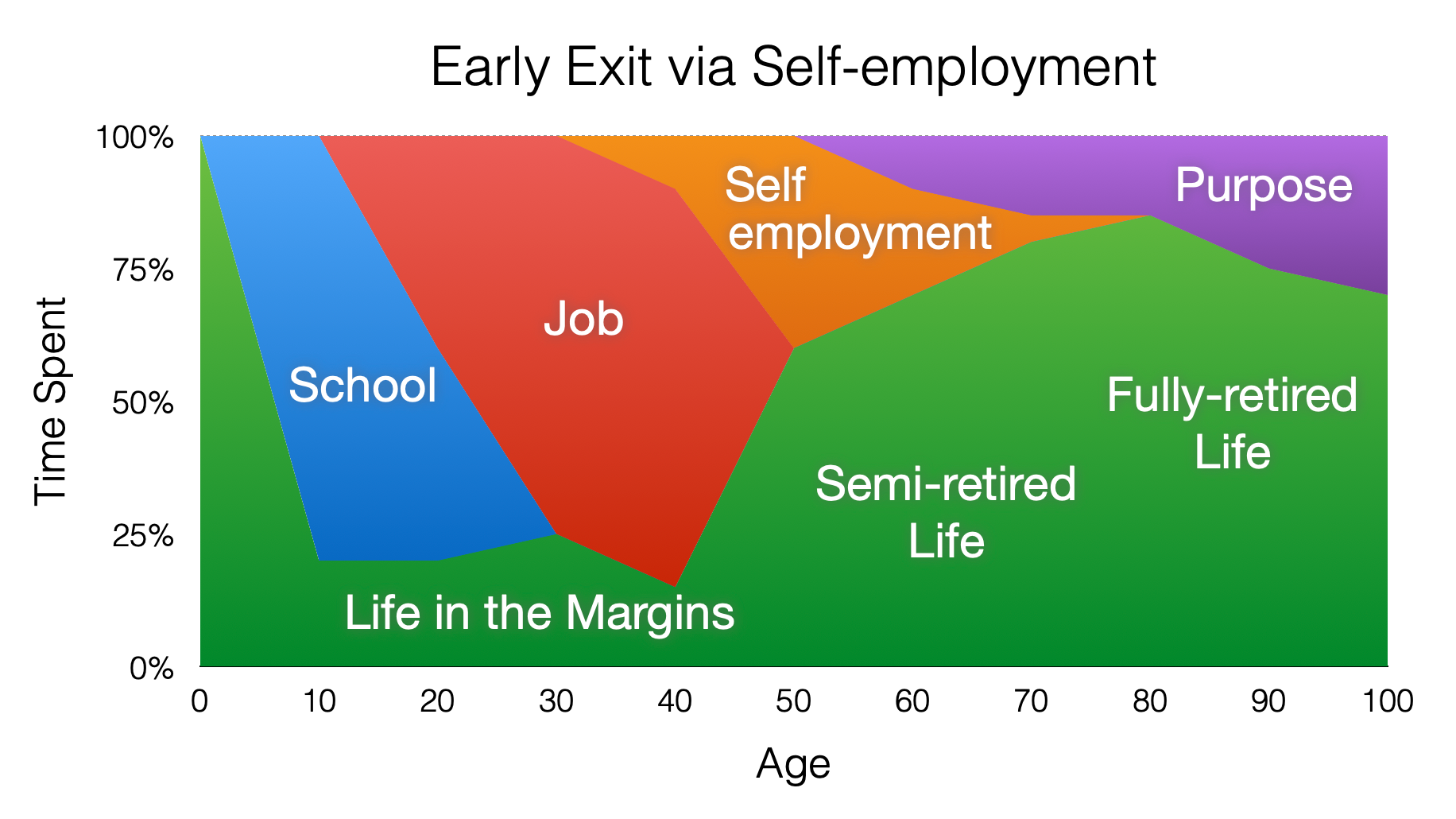
Again, we enjoy our early childhood before school comes into the picture. That doesn’t change (unless the entire educational system changes!).
And again, we live our personal lives in the margins while we are in school and enter the working world. But, the key difference is how compressed that 9-to-5 phase can now become.
Notice how you begin designing and safely testing self-employment models while you are still employed in your 30s and 40s. This can be valuable additional income. But, more importantly, you are setting the stage for your early exit from the 9-to-5 world in your late 40s to early 50s.
A combination of self-employment income, smart investments, aggressive savings and budgeting, and lifestyle design lets you create a life where work and life flow back and forth under your full control. You can think of this as a self-employed version of Barista FIRE.
Without an employer, boss, and the rules of a traditional job, you decide how you work and live.
What days you work, and the days you take off.
What the nature of your work looks like.
How and where you perform your work.
The hours you work every day (or not).
With whom you work and partner.
At some point, you may still decide to go into full retirement and stop working completely. With self-employment, you have continued to feed your investments and reduced what you are pulling out of your retirement fund and social security. So, you have earned the right to relax, play, see the world, and have fun!
You’ll notice that I bumped up the percentage of time for purpose. That’s because you get a chance to enjoy semi-retirement earlier in life. You don’t feel the same intense pressure to squeeze everything into those few final years of retirement, frantically checking off your bucket list. You are more relaxed and at peace, with more time for doing things that give you meaningful purpose (e.g., giving back and helping others).
Some suggestions
Do you see that overlap between Job and Self-employment that starts in your 30s? That’s when I think people should start thinking about and planning their future exit from their full-time job. Yes, it eats a little into your personal time, since you would work your job and create a self-employment strategy and plan on your own time.
However, there is an opportunity to “learn while you earn.” For example, one thing I think people should do (that most don’t) is treat their job as their chance to receive a “post-graduate education.”
Start planning what you want to do after your first career wraps up (e.g., the type of self-employed business you want to build), and look for opportunities to gain the knowledge, skills, experience, and connections while you are still employed and potentially through resources your employer offers.
For example, many people need a stronger knowledge of marketing and sales if they want to run their own business. So, look for internal training opportunities to gain those skills, seek an internal mentor who is great at those things, and see if your employer provides education reimbursement for courses you could take outside the company.
There is no such thing as guaranteed employment. I’m sure you’ve noticed the thousands of layoffs occurring over the past few years. A nice benefit of quietly designing, testing, and spinning up a small business is that it can provide some additional income while you are employed (who doesn’t need that?) and it can help support you if you lose your job.
It’s challenging to spin something up quickly if you’re panicking about lost income after a layoff. It’s pretty easy to dial things up with a business you’ve already established. For example, I know many people who have a side consulting business even though they are full-time employees. They completely control the hours they dedicate to the business and ensure there is no conflict of interest. When they are between jobs, they spend more time consulting.
So, if you’re interested in an earlier exit from your job that would also let you pull in your semi-retirement date, now is the time to work on your plan. Believe me, it’s nice to have options ready. And it’s pretty incredible to enjoy some of the perks of retirement at a much younger age than traditional timelines!
➡️ Want to discuss your goals and plans? You can schedule a free call with me.

From corporate exec to entrepreneur, Larry Cornett is a coach who helps you leverage your existing expertise to design a self-employment business that funds the life you want. Escape the 9-to-5 grind by creating your Exit Blueprint to freedom!
➡️ Ready to build your blueprint? Book a free call today to claim your spot.
Beautiful timeline!!